
Product design, data & AI
MusicWeave
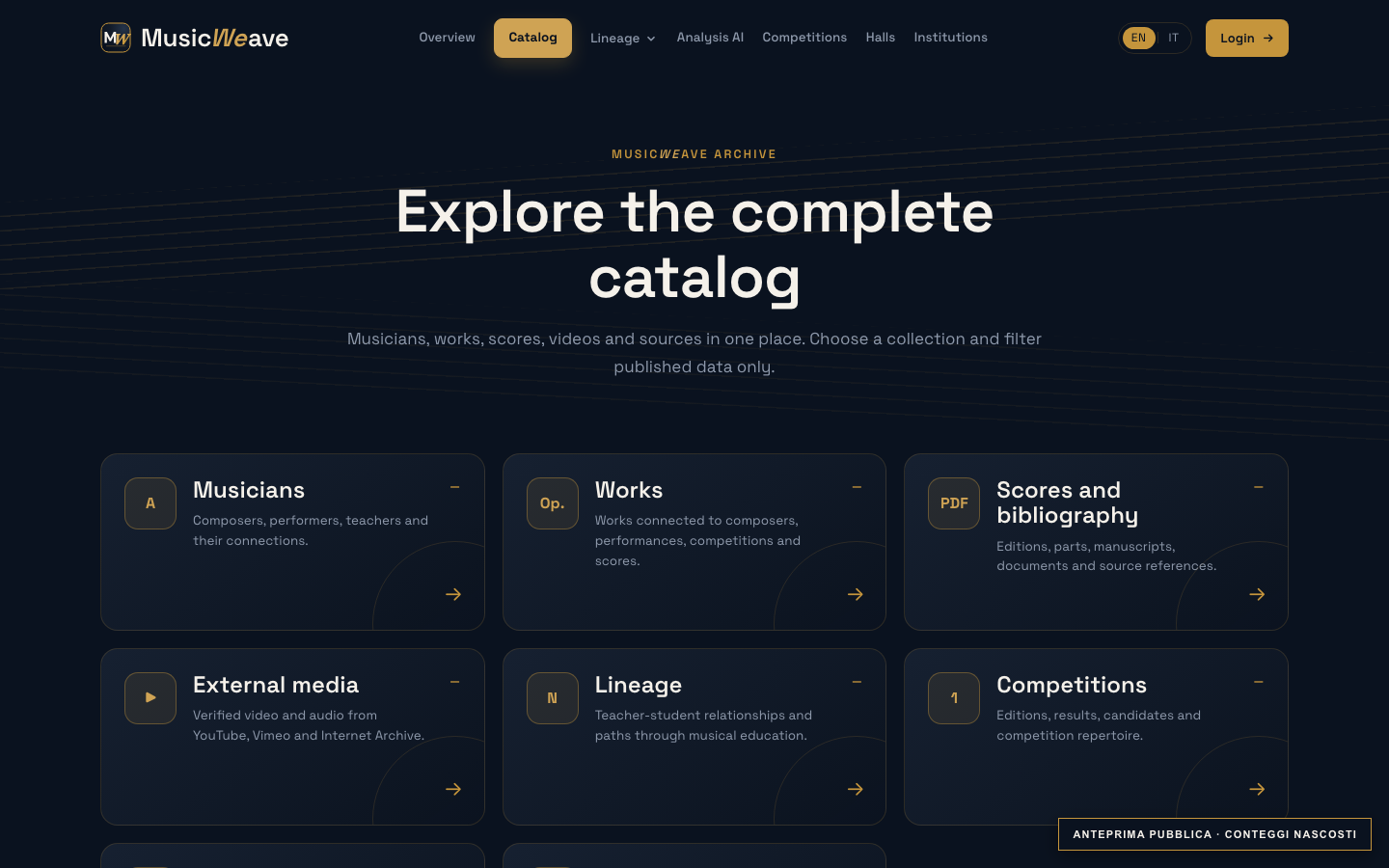
Explore classical music through the connections between musicians, works, institutions and performances, and see where each piece of information comes from.

Built for
- Musicians and students
- Researchers and enthusiasts
- Editors and catalogue operators
The problem worth solving
Connect information from different music archives while keeping its sources visible and uncertain matches open to review.
Andrea designed imports that can resume safely, links between related records and a history of their sources. The next step is an AI assistant that explains those connections using verifiable evidence.
How the system works
How the system works
- 01
Independent sources
Each provider is imported in small, resumable runs with its own limits and evidence.
- 02
Identity and provenance
Reliable identifiers converge on canonical entities; ambiguous matches remain separate and reviewable.
- 03
Knowledge network
Works, people, places, events, competitions, documents and media become traversable relationships.
- 04
Search and planned AI assistant
The planned assistant will use deterministic tools and cited passages to avoid inventing catalogue facts.
The complexity behind the simple flow
The complexity behind the simple flow
- Reconciling many providers without merging people or works on names and titles alone.
- Keeping every imported fact traceable to a versioned source while allowing corrections and conflict review.
- Separating deterministic catalogue facts from AI explanation, memory and future external research.
What changed
MusicWeave connects musicians, works, performances, competitions, institutions, documents and media while keeping the path back to each source visible.
The archive can grow across many sources without sacrificing the provenance needed for research, editorial work and responsible AI assistance.
Under the hood
- Laravel
- PostgreSQL
- AI orchestration
Project links
Bring the real constraints. I’ll help turn them into a product people can actually operate.